
Free Home Delivery
A1CNOW® SELF CHECK
TAKE CONTROL OF DIABETES
$75 only for 1 YEAR

F.A.Q.
What is A1c?
Why is an A1c test useful?
HbA1c or A1c tests can measure the level of glycated haemoglobin (HbA1c) in your blood. This is a good indicator for blood glucose levels over a period of 8 – 12 weeks.
Knowing your HbA1c level is particularly useful in diabetes where good glucose control is essential. A reduction in HbA1c has shown to reduce the risk of certain diabetes-related complications.
This measurement can also be beneficial in general health checks directing you to seek appropriate medical advice if needed or check the progress of your positive lifestyle/diet changes.
How does the A1cNow® SELF CHECK system work?
The A1cNow® SELF CHECK uses a system of chemical reactions to measure the A1c levels in your blood.
Can I purchase more cartridges?
The 4 test pack provides a whole year’s worth of testing (once a quarter) equipment to the user. You cannot purchase extra strips for that meter as it is programmed for testing just four times. The battery life on the meter would not allow any more tests to be carried out on the meter.
Does it hurt?
No, the testing process is painless however a blood sample is needed, which is collected using a sample collector from a finger prick. The finger prick is done using a lancet provided in the kit. This has been described as a sharp scratch..
Do I need a lot of equipment?
Not at all. All you need to perform the test(s) are provided in the kit. No additional equipment is needed.
What are the side-effects?
There are no side-effects as the test is performed outside your body. However, a finger prick is required to obtain the blood sample, which may be slightly uncomfortable for some people.
How accurate is the A1cNow® SELF CHECK?
The A1c Now® SELF CHECK has been certified by the National Glycohaemoglobin Standardisation Program (NGSP) which develops standards for A1c tests. The NGSP ensures that A1c results are comparable to the Diabetes Control and Complications Trial (DCCT).
It is unlikely that your A1c Now® result will match the A1c result obtained from your medical professional or laboratory. In these clinical environments, different technologies from the A1c Now® SELF CHECK are used to determine your A1c. Every test, be it laboratory to home testing has a degree of variation. The A1c Now® result can differ from -11 to +9 mmol/mol from your true A1c result. This means that if you have a true A1c of 53 mmol/mol, the A1c Now® SELF CHECK result may be between 42 to 62 mmol/mol
It is very important that you discuss the use of this test and test results with your medical/healthcare professional, especially if the result widely differ from the results obtained in clinical settings such as laboratories. Do not make any changes to your treatment, lifestyle or diet based on the A1c Now® SELF CHECK without consulting your doctor. These tests do not replace regular blood glucose monitoring or the doctor’s advice/treatment plan.
If it is not as accurate as laboratory tests, then why should I use it?
The A1c Now® SELF CHECK has been certified by NGSP and accuracy tests to ensure the device meets the strict requirements. It can be performed at any time, in any place and does not require fasting or special diets. Results are available in 5 minutes so you know your A1c levels there and then.
The A1c Now® SELF CHECK is not designed to screen or diagnose diabetes – only a trained medical professional can do this. It is simply designed to help you monitor your glucose levels over an extended period in the comfort of your home helping to direct you to seek medical advice when needed, or see the effects of your lifestyle choices.
Do not make any changes to your treatment, lifestyle or diet based on the A1c Now® SELF CHECK without consulting your doctor. These tests do not replace regular blood glucose monitoring or doctor’s advice/treatment plan.
How does A1C relate to glucose control?
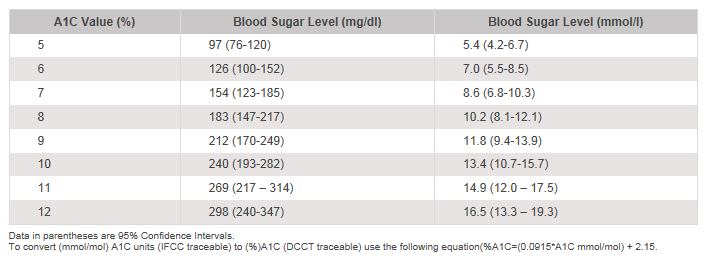
- Nathan, DM, Kuenen, Borg, R, Zheng, H, Schoenfeld, D, Heine, RJ. “Translating the A1C Assay Into Estimated Average Glucose Values” Diabetes Care Volume 32 (8), August 2008.
- NGSP Website: http://www.ngsp.org/ifcc.asp
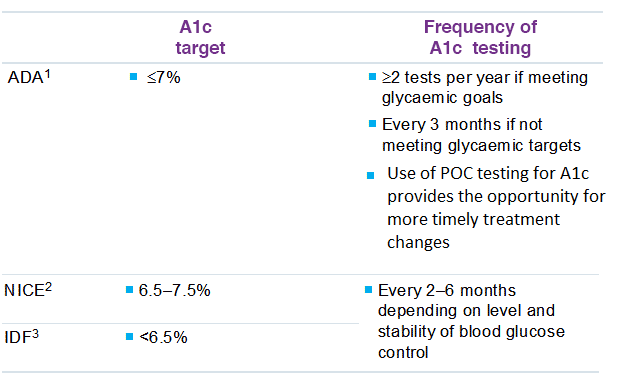
What role does A1C play in diabetes standards of care?
References
- ADA Diabetes Care 2014; 37 (Suppl 1):S14-80
- https://www.nice.org.uk/guidance/qs6
- International Diabetes Federation. Recommendations For Managing Type 2 Diabetes In Primary Care, 2017. www.idf.org/managing-type2-diabetes
Less stringent treatment goals than those noted in the chart above may be appropriate for patients with a history of severe hypoglycemia, patients with limited life expectancies, very young children or older adults, and individuals with comorbid conditions.1
References
-
- American Diabetes Association. Executive Summary: Standards of Medical Care in Diabetes-2009. Diabetes Care, 32 (S1) 2009, pp. S6-S7.
I read some negative reviews – I am not sure if this is a good product?
The A1c Now® SELF CHECK is a PTS Diagnostic product. PTS Diagnostics are known for their innovative and accurate technology.
How often should I test my HbA1c levels?
The answer is that people with diabetes should talk to their physician about how often they should test their A1C.
The Mayo Clinic recommends on its website that A1C testing varies dependent on the type of diabetes the person has, the treatment plan and how well the person with diabetes is managing their blood sugar. For example, the A1C test may be recommended…
People with diabetes may need more frequent A1C tests if the physician changes the diabetes treatment plan or the patient begins taking a new diabetes medication.
Who is the test not suitable for?
- Pregnant women
- Children and young adults
It is advised that if the following condition(s) affect you then you should consult your medical/healthcare professional before you use this test:
- different haemoglobin variants
- bleeding disorder(s)
- conditions that affect the blood or haemoglobin e.g. anaemia
- heavy bleeding
- kidney disease
- liver disease
Address
639 N 13th Ave Upland, CA 91786
Phone
909-532-5588
dcrxupland@gmail.com
Customer Service
For any inquiry or request for a refill, transfer or compound a prescription for you or your family or your pet, just call us on this number during the office hours
(909) 532-5588
dcrxupland@gmail.com
Emergency Hotline
We will try our best to help you and fill your prescription in emergency situation , just call or text this number only if out of office hours
(909) 532-5588
dcrxupland@gmail.com
LTCF Inquiries
you can reach out to us if you have any inquiry or request regarding any long term care facility or nursing home, just call or text us on
(909) 532-5588
dcrxupland@gmail.com
24/7 Live Chat Support
Chat With An Expert
Quisque velit nisi, pretium ut lacinia in, elementum id enim. Donec rutrum congue leo eget malesuada. Proin eget tortor risus.
F.A.Q.
Do you deliver to my home?
Absolutely, we, at Doctor’s choice pharmacy offer a free delivery to all upland city, Rancho Cucumango , Ontario, San Bernardino , Riverside, Corona, high land and Redland.
What is compounding Medication?
A compounded medication is a drug that is specifically mixed and prepared for you, based on a prescription from your doctor. Creating compound medications involves mixing one or more active ingredients, each at a specified amount.
Do you offer Covid-19 Vaccine ?
Yes , Doctor’s Choice Pharmacy offers all kinds of Covid-19 Vaccine including Pfizer 1st and 2nd Dose , Pfizer 1st and 2nd Booster , Moderna 1st, 2nd Dose and Moderna 1st and 2nd Booster. We Also offer Pfizer kids vaccine 3 years and up and Moderna Kids vaccine As well.
Walk-ins are welcome without appointment and If you prefere to book appointment , you can use this link https://forms.gle/yP8CnxVWbre68Vf68 or myturn .
Do you offer covid-19 Test ?
At Doctor’s Choice Pharmacy , We offer Rapid Antigen test (15 min ) with a printed report or report that can be sent to your email within 15 min.
This Covid-19 test cost $95 , Walk-ins are welcome for this test and appointments as well through this link https://docs.google.com/forms/d/e/1FAIpQLSddNSngeIPsvkFBlh8-dWM0EpMjfQKp4T67BWuDfScc_Icx1Q/viewform
Do you offer free Covid-19 test kit ?
Yes, We Do offer home test kit that might be covered by your insurance for up to 8 test per person with $0 copay
or you can buy it over the counter for $9.99 per test or
Do you offer the new therapeutic Covid-19 treatment (Paxlovid) Free ?
Yes, we dispense Paxlovid Free of Charge with $0 copay to everyone with or without insurance
( The FDA has authorized the emergency use of PAXLOVID, an investigational medicine, for the treatment of mild-to-moderate COVID-19 in adults and children (12 years of age and older weighing at least 88 pounds [40 kg]) with a positive test for the virus that causes COVID-19, and who are at high risk for progression to severe COVID-19, including hospitalization or death, under an EUA. ) For more information you can visit https://www.paxlovid.com
Phone
(909) 532-5588
Location
639 N 13th Ave , Upland. Ca 91786
info@doctorschoicerx.com
Store Hours
M-F:9am - 5pm
S-S: Closed